


 16 / 24

ROMANIANTIMES
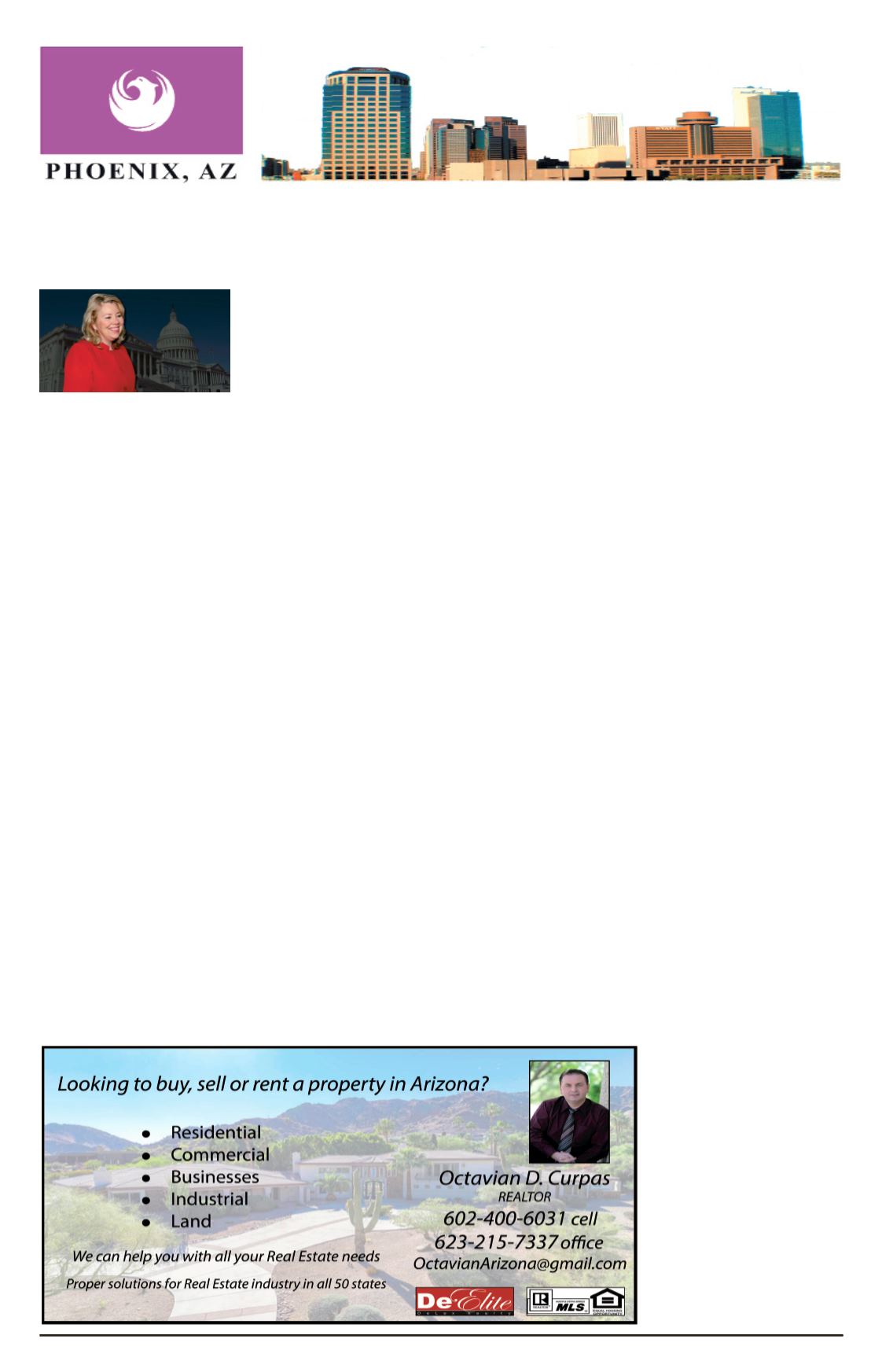
A conversation with U.S. Congressional candidate Debbie Lesko
Debbie Lesko is a conservative American
politician and a Republican member of the
United States House of Representatives,
representing Arizona’s 8th congressional
district. She previously served as a member
of the Arizona Senate from 2015 to 2018,
representing the state’s 21st district. She
also was President pro tempore of the
Arizona Senate from 2017 to 2018. Debbie
Lesko also served as a member of Arizona
House of Representatives from 2009 until
2015.
Lesko won the Republican nomination
for Arizona’s 8th congressional district
special election to replace Trent Franks,
who resigned from Congress, on February
27, 2018. She won the election on April
24, defeating Democratic nominee Hiral
Tipirneni with 52.4% of the vote to
Tipirneni’s 47.6%.
Debbie Lesko is also an Evangelical
Christian, she is an active member of
Palmcroft Baptist Church in Phoenix.
-
Canyouplease tell usa littlebit about your
background and your journey from a state
senator to the House of Representatives?
-
I served in the Arizona House of
Representatives before becoming a state
Senator for LD21. In the Arizona Senate,
I served as Chairman of theAppropriations
andFinanceCommittees,aswellasPresident
Pro Tempore. When Congressman Franks
unexpectedly resigned, I was encouraged
to run for the open seat. I beat 11 opponents
in the primary and won the special election
in April. On May 7, I was sworn in and
have been serving the people of Arizona’s
8
th
Congressional District since, and I look
forward to continuing to represent our
district in Congress.
-
What are you most proud of about your
work/life?
- I ammost proud of being able to serve my
fellow Arizonans and make a difference
in people’s lives. This is my home, and I
“The Romanian community is an integral part of our state”
humbled by the opportunity to represent
my community in the U.S. Congress.
- What is the biggest challenge you face in
your position as a congresswoman?
- The biggest challenge for me was a quick
transition into Congress. I was sworn-in
and immediately handed my voting card
and told to vote. I had to make quick
adjustments, like hire a new staff, find a
place to live in D.C., and learn the Capitol
and House rules. Although there are many
similarities, it is much different than the
Arizona legislature. What was different
for me was that most members at the start
of a new Congress are guided through the
transition, but that doesn’t happen when
you win a special election.
- Probably for many of the constituents in
Arizona and in the U.S. the main concerns
are: the job situation and the National
Debt.
You mentioned that you are committed to
cutting wasteful government spending,
stating that the federal government must
live within its means. Can you please share
more details on this and eventually name
some projects that the government should
not fund?
- Our national debt is out of control,
and frankly, it is a threat to our national
security. I have always been a good
steward of taxpayer dollars and take that
into consideration when I decide to support
legislation. A good example of wasteful
government spending is all the money
that Congress appropriates to various
agencies that just sits in accounts and isn’t
spent. That is why I supported bills such
as H.R. 3 — the
Spending Cuts to Expired
and Unnecessary Programs Act
. The bill
included almost $15 billion in rescinded
spending previously authorized by law.
That is money we could have easily used
elsewhere or put towards reducing our
debt.
- What areas do you consider that the
government should reduce the spending?
-
We should evaluate all areas of
government spending to see what can be
cut or reduced.
- On June 28th, 2018, you introduced your
first bill since being sworn into Congress.
H.R. 6259, the Make Education Local Act
of 2018, would allow individual states to
submit their own education plans, known
as a State Management Decision, to the
Secretary of Education. What were you
hoping to achieve when you proposed this
law?
- Education is one of my highest priorities
in Congress. I have visited 11 schools
across the district to observe classrooms
and discuss education policy with teachers
and administrators. I have found that
our local schools know their students
and their needs best—not bureaucrats in
Washington. My bill allows the states to
set their own education plans free from
burdensome Washington mandates.
Ultimately, this puts more money into the
classrooms for our students and teachers
to improve the quality of education rather
than being spent to comply with all the
regulations.
-“The regulationsand taxesofObamacare
havecrippled thehealth insurance industry
and increased premiums substantially for
American individuals, families, and small
businesses”. How do we develop a health
care plan that is affordable to all?
- Health care decisions should be made
by the individual—not the government.
Freedom and choice in the marketplace
allows people to choose a plan that fits
their needs, and ultimately lowers the cost
for them and for others. The Democrats’
idea for a government-run health care
system will take away choice and
competition in health care, cost taxpayers
$33 trillion, raise taxes, and be a disaster
for our country.
- Perhaps you remember that people here
in Arizona a couple of years ago joined in
the world-wide demonstrations against the
child protection agency in Norway, which
had taken five children from their parents
(Bodnariu family) and were planning for
the children never to come back to their
family, although that family was very good
indeed. People in different parts of the
world are beginning to be very concerned
about unwarranted actions from theirDCS
organizations in many Western countries.
What are your thoughts on the situation
here in Arizona and the USA?
- While I served in the Arizona Senate, I
workedwithArizona’sDepartmentofChild
Services (DCS) to make reforms. Starting
July 1, 2018, court orders are needed before
Arizona DCS can remove any children
from their homes. I believe that parents and
children should have similar due process in
a court of law throughout the nation.
- Do you think there a law that theCongress
could enact that would really make a
difference in reducing gun violence and
building safe communities?
- This is an issue that cannot be solved by
a single bill, but there are steps that we
can take to make our communities safer
and tools we can provide. For example,
I cosponsored legislation that creates a
school safety grant program at the U.S.
Department of Education to keep our
schools and our students safe (H.R. 5107).
I am a strong supporter of the Second
Amendment, and I have been endorsed by
the NRA.
- Are you concerned that people see the
Republican Party more closely tied to what
people call “white nationalists” and that
association effects minority outreach?
- The Republican Party is accepting of
everyone and works to advance policies
that benefit all Americans. A few extreme
voices do not speak for the millions of
honorable Republicans in our county
committed to racial equality.
- What solutions do you propose to solve
the immigration problem?
- First and foremost, we must secure the
border. My border plan includes a physical
barrier at our southern border, increased
technology, and more boots on the ground
to end the problem of illegal border
crossings. It is important to remember that
our border isn’t just our outer perimeter, but
our air, land, and sea ports of entry as well.
My bill to evaluate our ports and make
them more secure passed unanimously in
the House in September – H.R. 6400, the
United States Ports of Entry Threat and
Operational Review Act.
-Yourecentlymetwith thepresidentDonald
Trump and talked to him about this issue.
What exactly did you discuss?
President Trump and I agreed that we must
secure the border. We both want to end
the problem of illegal immigration once
and for all and close all the loopholes that
exacerbate this. We are both committed to
solving the crisis at our border.
- I am sure you are aware of the cases that
continue to be brought against Christians
regarding their freedoms of choice. Do
you feel that we are going in the right
direction when it comes to constitutional
freedom to profess our faith and serve our
community based on our believes without
fear of discrimination, punishment, fines or
penalties from government?
- As a Christian, I believe we should be
able to practice our faith freely without
government intrusion or being forced to do
(continuare in pagina 20)